Showing posts with label theology. Show all posts

Thursday, 23 August 2012

Is hope good or bad?

Recently I've watched both The Shawshank Redemption (for the first time) and The Hunger Games (again). They are, of course, two completely different films - the former is about Andy Dufresne who is sentenced, wrongly, to life imprisonment and his experiences inside and, ultimately his desire to be free; the latter about a society in which rural districts are kept in poverty by the ruling Capitol who use an annual televised death match contested by young 'tributes' from each district as a tool to punish the districts for their past rebellion and keep them in line.

However, watching them so close together, I was struck by one theme in particular that they have in common - hope.

It comes out very strongly towards the end of The Shawshank Redemption in a conversation between Andy (Tim Robbins) and Red (Morgan Freeman):

Andy Dufresne: That's the beauty of music. They can't get that from you... Haven't you ever felt that way about music? 
Red: I played a mean harmonica as a younger man. Lost interest in it though. Didn't make much sense in here. 
Andy Dufresne: Here's where it makes the most sense. You need it so you don't forget. 
Red: Forget? 
Andy Dufresne: Forget that... there are places in this world that aren't made out of stone. That there's something inside... that they can't get to, that they can't touch. That's yours. 
Red: What're you talking about? 
Andy Dufresne: Hope.
 Andy recognises the power of hope, but Red also points out the danger of hope in a later conversation, when Andy's hopes of acquittal have been crushed:
Red: Let me tell you something my friend. Hope is a dangerous thing. Hope can drive a man insane. 
A similar sentiment is expressed by President Snow to the Head Gamemaker Seneca Crane, as events in this year's games are starting to provoke unrest in the outlying districts:
President Snow: Hope, it is the only thing stronger than fear. A little hope is effective, a lot of hope is dangerous. A spark is fine, as long as it's contained. 
Seneca Crane: [confused] So... 
President Snow: So, contain it! 
President Snow & Seneca Crane. Good facial hair, but it won't end well. Source.
All three men understand that the hope of a better future is a powerful thing to have inside of you. Andy sees it as a force that can make you strong against all opposition. Red, on the other hand, recognises the danger of uncertain hope - hope that does not come to fruition will ultimately crush you into a depression worse than anything experienced by those who just accept that their life isn't going to get any better. Snow identifies the power of that hope as a tool that can keep people in line - it is more powerful than fear, because it comes from within rather than being imposed from outside. But what is the nature of the hope that these men talk about? The final lines of The Shawshank Redemption are quite telling:
Red: [narrating] I find I'm so excited, I can barely sit still or hold a thought in my head. I think it's the excitement only a free man can feel, a free man at the start of a long journey whose conclusion is uncertain. I hope I can make it across the border. I hope to see my friend and shake his hand. I hope the Pacific is as blue as it has been in my dreams. I hope.
Morgan Freeman, Tim Robbins fom Shawshank Sedemption
Red & Andy meet for the first time. Source.
It is an uncertain hope, a wish that things will turn out the way they want. In the end, Andy uses his hope as a drive to escape, fleecing the crooked warden in the process. His hope is fulfilled, but what if he had been caught at the end? What if he hadn't got away? I imagine the depression would have driven him to suicidal despair.

The apostle Paul recognises the futility of false hope:
32 If I fought wild beasts in Ephesus with no more than human hopes, what have I gained? If the dead are not raised,
“Let us eat and drink,
    for tomorrow we die.”
  - 1 Corinthians 15:32 (NIV) 
An uncertain hope is a dangerous thing, it can turn on you, destroy you. But that's not the kind of hope that Paul talks about:
Therefore, since we have been justified through faith, we have peace with God through our Lord Jesus Christ, through whom we have gained access by faith into this grace in which we now stand. And we boast in the hope of the glory of God. Not only so, but we also glory in our sufferings, because we know that suffering produces perseverance; perseverance, character; and character, hope. And hope does not put us to shame, because God’s love has been poured out into our hearts through the Holy Spirit, who has been given to us. - Romans 5:1-5 (NIV) 
 The Christian does not have a vague, wishful hope of Heaven and future glory. No, the Christian's hope is sure and certain. We do not put our hope and trust in the things of this world to satisfy us, but rather, looking forward we know that God will resurrect the dead and give us new, imperishable bodies and bring us to Heaven. Why? Because Jesus has already accomplished the victory - the result is certain!

Conclusion? We have a hope inside us that is not weak, to control us, our vulnerable, to crush us, but it is strong and guaranteed - that is the Bible's definition of hope. It's not an indefinite 'I hope it doesn't rain today', it's a certain 'I know that I will be in Heaven forever'. This hope is why Paul can say:
16 Therefore we do not lose heart. Though outwardly we are wasting away, yet inwardly we are being renewed day by day. 17 For our light and momentary troubles are achieving for us an eternal glory that far outweighs them all. 18 So we fix our eyes not on what is seen, but on what is unseen, since what is seen is temporary, but what is unseen is eternal. - 2 Corinthians 4:16-18 (NIV)
When all is said and done, whatever people may say, whatever may happen, however we may fail, we are secure in Christ, and He will surely bring us to glory. So take courage, and pray that God will help us to fully comprehend the implications of this.

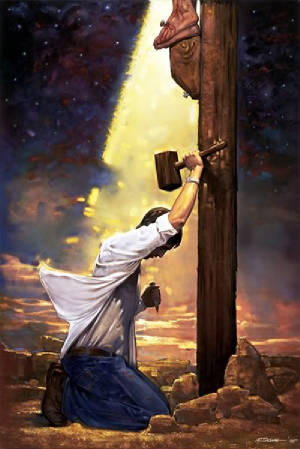
Friday, 11 May 2012

The Trinitarian God Part 5: Our mind-blowing salvation

This is the last post on my series on the Trinity, although I hope it is not my last on this subject!


In the last post I talked about the wrath of God being the response of His love to evil. I also started to talk about how out of His abounding love God does not leave us in the mess we've made, but has made a way out. He paid the price of our sin, bore the consequences, and offers us salvation freely. This is the Gospel - good news. However, a lot of people might be able to regurgitate the idea that Jesus died for our sins, to forgive us. So let's go a bit deeper into what's going on - the Trinity reveals something truly amazing.

First, consider what happens when Jesus comes to earth. He is God, He has been part of the intimacy and security of the Father-Son-Spirit loving family for all eternity, yet He 'contracts Himself to a span' and becomes one of His created beings - that's so mind-stretching, I can't really think of a great way to describe it. The idea of the one who created the world (see John 1) becoming a suffering, limited human being is beyond words.
But more than that, He came, the immortal, eternal, God the Son to die. He knew why He came, He knew the purpose of His coming - He came to do what no other 'god' has ever done willingly - to die. All His life, He lived, knowing His fate, and He chose it.
Our sins nailed Him to the Cross - but it is at the Cross that He won our salvation. Source here.
Now think about what happens at the Cross. The Father and the Son have been defined by their love for one another for eternity, and yet at this one point in our history, the relationship is broken, the Father turns His love away, and treats the Son, not as His obedient Son, but as an enemy - as one of those who has ruined everything - think how that must feel. I guess the closest you can get is to imagine how you would feel if the person who showed you the must love throughout your life, who had loved you unconditionally for the 70 years of your life, who you had also acted towards with nothing but selflessness and kindness turned on you and attacked you and insulted you and treated you like you had ruined their life - only much much worse. And yet that was the plan, the Son who had done nothing but obey the Father was treated like an enemy, in the exact moment He was being most obedient. And that is what it took to bring us back to God - that is what it required to make us clean and new and good. That's what your God did for you.
But it gets better than that. It's not just the extraordinary act of sacrifice to forgive us, it is the fact that now the Bible says we have been adopted into God's family. We are children of God. You know how God the Son is called God the Son? Well, the Bible says we are in God's family, 'in Christ' - which means that through Christ, we are also in the Trinity. We are no longer enemies, but we have been invited into the overflowing love of the Trinity through Jesus - we are a part of that now. Ever wonder how much God loves you? That's how much. That's also how secure you are, Christian. You are bound as tightly to God as the persons of God are to each other - God will never let you go.

No other belief in the world offers you such a God - a God who created you to love you, who is so selfless that He comes to save you, forgives you, suffers for you, does it all for you, and then invites you to share in the relationship that is part of His very being. That is why the god that philosophy and popular culture thinks of is not the God of the Bible at all. Only this God is worth worshipping, worth following, and boy does He give us a million reasons to. Wow, just wow.


Well, thank you for following this series, I hope it was encouraging. If you want more of that, phrased more eloquently than my splurging, read Denise's transcripts of or (even better) listen to these talks on the Trinity by Mike Reeves. If you read nothing else ever, outside the Bible, read these, please. I'll even beg if it helps:
The Heart-Winning God
The Loving Father
The Beautiful Son
The Heart-Melting Spirit

Thursday, 10 May 2012

The Trinitarian God Part 4: God's wrath is good

This post is part 4 in my series on the Trinity - don't worry, we're nearly there! I hope it's as helpful to you reading as it is to me writing.


You may be wondering about the title of this post. God's wrath is often an uncomfortable subject - and I think rightly so. It's a terrible thing to be on the receiving end of. The temptation these days is often to play down the notion of God's wrath and play up God's love when we tell people about the Gospel. The problem, of course, is if we leave out wrath people don't know what they need saving from, and we end up with this sense of disconnection between the God of the Old Testament and the God of the New. This simply comes from misunderstanding God, and misunderstanding the nature of love.


So I've said a lot about God being lovely, beautiful, loving, selfless and you may well be wondering how God's wrath fits into that, is it a contradiction? Sometimes people say 'God is loving, but He's also holy' (I explained in the last post why that's a tautology), or 'God is loving, but He's also just', as if God's wrath is a flip side to God - that you might get Loving God, but you might also get Angry God. But if we apply what we've already learnt - that God is love, we can see that God's wrath is a consequence of His love. If that doesn't make sense, consider again what we've already looked at. God created the universe to spread love and goodness and beauty - so when He sets Adam and Eve up in the Garden of Eden, that's the idea. So when they reject God by disobeying Him, what are they doing? They are rejecting love, goodness and beauty. But it's not just them that are affected, it's everything. Everything is ruined by sin. Sin is best characterised by acts born from selfishness and pride - rebellion against God, and therefore rejection of goodness. Sin is evil and rips the world apart. Sin is not fun and freedom, it's slavery and death.

So God's wrath is the response of love to evil. True love does nothing else. He has created a beautiful universe, and evil has ruined it and harms those who live there. Evil done by us. So God is wrathful against those who are bent on bringing evil into the world He has made - those bent on ruining it and hurting those He loves. Don Carson has pointed out that there are no repentant people in Hell - those in Hell are bent on rebellion, bent on rejecting the love of God - bent on ruining the world. If you want love without wrath, you have no love at all. If that still doesn't make sense, think for a moment about your family (children, parents, girlfriend, spouse etc.) and friends - think how you'd feel if someone threatened them, attacked them, harmed them and was determined to keep doing so - would you say 'I don't mind, that's alright, live with us anyway?' - if you did, I think you could not claim to love your family! God is ready and waiting to forgive all those who ask for it, and to make them good - but those who are determined to reject Him and ruin His world and hurt His Family - they are the ones He displays His wrath against.

God's wrath against Christ displays His love to us. Source here.
The consequence of this is that judgement is actually what we deserve - we are all rebellious and are all ruining the world. We deserve to be discarded like a burnt cake, given up as a bad lot. But because God is loving in such an amazing, spectacular way, He doesn't simply respond to our rebellion with anger - He offers us forgiveness, He offers us restoration, He offers us peace and a way back to Him and invites us into His new world of love and beauty - He offers us a way to be saved, freely, so that we don't have to have the Hell we deserve. Nno works are required, simply acknowledging that we have sinned and have made a mess of His world, and wanting to live a life of love and goodness instead - He has done all the hard work.

So when you think of God's wrath, don't just think in legal terms - as if we have broken some arbitrary laws and offended an emotionally fragile deity. Think of the God who is love, and think of the ways that humanity brings ruin and hurt to this world and to those living in it. Then think of a God who loves enough to protect those He loves from evil.

But don't stop there either, in the next post I'll talk more about the glorious, amazing redemption He offers us  freely. Why? Because He loves us.

The Trinitarian God Part 3: Selfish narcissism? No, selfless love.

This is part 3 in my series on the Trinity - I hope you will get to see how amazing God really is when you think about Him as the Bible describes Him.


In the last post I talked about God creating the universe out of a desire to share his overflowing love. I should also add something that people will often tell you in Christian circles: God created the world for His glory. So have I just contradicted myself? Is God actually less selfless than I suggested? I think when we understand God's glory correctly, then we will also understand that these two ideas are actually very very similar.


I don't know about you, but unless properly defined, the phrase God acting for 'His own glory' rings a bit false to me. It makes me think of a superbeing standing at the top of the universe shouting 'look at me, I'm magnificent'. Now, a being with the power to create the universe has that right perhaps, because he is magnificent - but it doesn't ring true with what we see Jesus is like, what God tells us to be like, and, well, the idea that God is loveable. The God that I read about in the Bible (revealed by Jesus, John 14:8-11) serves others and is humble and tells us to be the same. And one thing we know is that God is not a hypocrite. This is the consequence of, again, defining God without 'Trinity', as a single person - the god of philosophy tends to come across as either selfish or needy - either needing or demanding our praise to build up his inadequate ego.

Mike Reeves (again!) puts us straight on what God's glory is and what glorifying God means. First, an important point, glorifying God does not mean 'making God more glorious', as if He needs a reputation boost from us - He's not that desperate. Glorifying God means making His existing glory known. So what is His glory? It is His holiness - and that is what makes God who He is.
The problem here though, is that we don't really appreciate how lovely true holiness is. Holiness is often pictured in our thoughts as being austere, defined more by what we aren't and what we don't do than what we are. We often fall into the trap of thinking holiness means 'not doing x sins'. Not so.
If the Heavens declare the glory of God - does it not make sense that He is beautiful? Source here.

I'll let Reeves do the work (seriously, just read that post, he is very eloquent):
Our God is, his holiness is that he is sweet and pleasant, a fountain of overflowing love. And real godliness means becoming just like that. Knowing God we become ever more attractive, ever more warm, loving, kind, generous.
So God is holy because He is loving, beautiful, overflowing in love, in fact. It makes Him different to us, because He has none of our selfishness and viciousness. So when we seek to glorify God, we aren't boosting His ego, we are simply becoming more like Him, sharing the love that defines Him with those around us. Glorifying God is fundamentally a selfless thing for us and God. With a God like that, why would you not want His glory to be made widely known - when His glory is abounding love! (See also Colossians 3:12-14Ephesians 4:32-5:2).

Now that makes sense - it means that instead of 'mean God, nice Jesus', we have 'lovely Father, Jesus the exact image and likeness of God the Father'. If you ever think that Jesus seems nicer than God, you've got God wrong. When you look at Jesus, see Him washing His disciples' feet, dying on the Cross - you are seeing what God is truly like.

So when God works for His glory, it's not selfish because it means that God is working to show His love forth.

But it goes further than this, because maybe that phrase 'God glorifying Himself' still sounds a bit selfish to you. Read this article on Glen Scrivener's blog, and perhaps think about it a little differently. The thing you notice about the Trinity is that they never act out of self interest. The Son always acts to glorify the Father, never Himself; the Father is always acting to glorify the Son, not Himself. The Father is the great planner of the Trinity, but He doesn't plan to increase His own reputation - when I say the universe was created for the glory of God, I mean, the Father planned the whole course of history, and the course of salvation history particularly, so that we would have the opportunity to see how amazing and loving the Son is. So God doesn't flip the rules around and say 'you guys be humble cos you're created, but I'm going to be different because I'm the best', He says 'be humble, be selfless, be loving, because I am, and that's good'. Jesus is humble and selfless, not because He's acting nice because He's a man on earth, He's like that because that's what He's like. But if your god isn't Trinitarian, he can't do that - god glorifying god is selfish unless it is other-centred - and only in the Trinity is that possible.

So God is selfless and loving - next we'll see how that works out when we mess it all up.

Wednesday, 9 May 2012

The Trinitarian God Part 2: The Loving Creator


This is part 2 in my series on a vital and distinctive Christian teaching: the Trinity.

Do you ever ask yourself what God was like before He created the world? Do you ever wonder why God created the world? A lot of the times when we explain the Gospel we do it in a law-centred way: 'we've broken the law and we deserve punishment', but this means that we end up talking about God as being first and foremost the law-maker. This means you end up with a god not unlike a speed camera - he enforces the law, and you may be grateful if he lets you off, but it's hard to really love him (Mike Reeves' illustration not mine!). So if God is not first the law-maker, what is He like?

Mike Reeves describes the conclusion we must draw from a singular god creating being that he is lonely! Kinda obvious when you think about it - a god who is just himself throughout all eternity doesn't actually know how to love - except maybe himself (which is called selfishness). So when he creates something he either does it because he's lonely, or because he wants to indulge himself and create a bunch of people that will be suitably impressed by his power and will therefore worship him and do what he says. He's all about self-gratification. Not a particularly attractive prospect! Yet this is the god that many people think of as being the Christian god, the Bible god. No wonder people become atheists! This is the god you get when you define god without the Trinity, the Father without the Son, without the Spirit. When atheists criticise god for being egotistical - they're often thinking of this singular idea of god and they're absolutely right. In actual fact the Bible does describe a singular being who exists to promote himself most of all - that's right, the Devil.
God creates not to show off His power, but to share His love. Source here.
Thankfully, the Bible doesn't ask us to believe in that God. The Bible asks us to believe in the Trinitarian God. That means that we don't have a lonely God, a God who doesn't know what love truly is. Rather, we have a God who has been loving from eternity past - the three persons of the Trinity love each other and serve each other - they are selfless - they're not ignorant about love, they're perfect at it! So that means that God doesn't create the world out of inadequacy or narcissism - He creates the universe out of love. In the same way that the ideal circumstance for conceiving a child is a married couple who love each other so much that they want to shower their love on another, the three persons of the Trinity love each other, if anything, too much - so they unite together out of an overflow of love and create the universe, and within the universe human beings in their image that they can relate to and love. So why did God create us? To love us. Think about that for a minute!

So God is not first and foremost a rule-maker, a cosmic dictator. God is first and foremost a lover, and He wants us to share in the happiness He enjoys. Now that's a God you can love!

Tuesday, 8 May 2012

God is not the 'god' of philosophy Part 2: The Trinity

I originally posted an article of about 3000 words that I realised that only a few people would have the inclination to read. So, obeying a rule of blogging, I'm going to repost it in more manageable chunks. This is the introduction, more to follow.

In my earlier post on the way western Philosophy approaches the question of God, I talked about the problem of starting with ourselves as the ultimate authority rather than finding out what God is like from Him. The consequence is that we don't know truly who God. He has to tell us. This means that we don't get the most important and distinctive teaching of Christianity and the vital implications of it.

These posts will talk about the Trinity. This is the teaching of the Bible that God is not a singular entity, but three persons - the Father, Son and Holy Spirit. Three persons who are distinct in their roles and yet equal and completely united by love and united in their purpose. Not one lump of 'god stuff' that appears in three different ways (that's called 'modalism'), but three persons. The best analogy is marriage as the Bible describes it - the idea of two people who come together as 'one flesh'. Deuteronomy 6:4 says 'the Lord is one' - but this is not 'one' meaning 'single', but 'one' meaning 'united'.


The three states of water analogy - that's modalism Source here.

This isn't polytheism either (belief in multiple gods - e.g. ancient Greece and Rome), note that the persons of the Trinity are named by their relationship to each other. God the Father is not like Zeus - Zeus would get on without the others because they are independent beings - the persons of God are more inter-dependent. If it seems hard to understand, don't worry - humans aren't trinitarian beings, so if you think you've totally got it, you probably haven't quite and a lot of erroneous understandings of the Trinity come from trying to bring it within human understanding too much. But that doesn't mean we can't get blown away by the implications of the Trinity.

You may be wondering at this point what makes this particular teaching so amazing, interesting maybe, but not setting your soul on fire (maybe it is already). Well, there are several things about God being trinitarian that makes Him absolutely wonderful, and will make you realise you never want to settle for anything less. I'll address them in each of the following posts, and hopefully you'll see how the Trinity impacts the way we think about everything in Christianity and why it is (apart from understanding salvation by Christ alone) the truth that has had the single biggest impact in my own Christian life.

Friday, 30 March 2012

God is not the 'god' of Philosophy: Part 1 Reasoning From Ourselves

I may be a computer scientist, but philosophy has been one of my casual interests for a few years. Recently, however, there's something about Western philosophy that bothers me. Western philosophy spends a lot of its time debating questions about God and whether God exists, which is fine, it's the most important topic there is, but the more theology I read, the more I feel that philosophy doesn't do a good enough job. In fact, what I've come to think, is that the approach to the question is fundamentally flawed.

It's a bit of a long old topic, so I'll do it over two posts, but I want to look at the key points that we really need to know about God that we just can't get from philosophy, and why.

Problem 1: Reasoning from ourselves
Philosophers are the intellectual descendants of the Greeks, via the Renaissance and the Enlightenment. What this means is that rationality is terribly important. In other words, if I think long enough and logically enough about something, I can work it. Well, that seems fair enough - that's basically how science works (with the addition of using experiments to establish the validity of the reasoning). But the problem is that it's actually a bit of an arrogant attitude, believing that everything is within the capacity of human thought - and so it works fine for the world around us that we can grasp, but when it comes to the transcendent, things beyond our environment, it's simply not enough.
'School of Athens' by Raphael - Aristotle & Plato in the centre. Source here.
I'll be frank, I'm fully convinced that we can establish the existence of a deity by looking at the world around us. I think it's patently obvious - and I think there's a certain degree of wilful blindness going on when it comes to thinking otherwise. However, even accepting that, it's difficult to go much further than that if we start from ourselves. Starting from me and my experience of the world, plus the experience of others, just doesn't give us enough.
Using the world and our reason as our only sources of information about a god leaves us with an open question, such as the Buddhist answer (the Buddha is quite an adept analyst of the problematic state of the world and how it seems to work, but Buddhism doesn't give us a lot of concrete answers about why it's that way), or perhaps with the polytheism of the ancient world (we laugh at the Greco-Roman ideas, but it had a certain logic to it - they were simply interpreting the world as they saw it), or perhaps the atheistic approach - which rather than explaining everything with lots of gods, tries to explain everything with no gods at all. These ideologies get some things right - they all identify that life is often full of difficulties and suffering (esp. if you live outside the shelter of the first world middle classes) - but they conclude that therefore, the ruling force behind it all is of the same temperament. The Greco-Roman gods were capricious and cruel, the blind forces of evolution are bloody and thoughtless, the machine of Karma is, whilst fair, unmerciful.
The Buddhist Wheel of Life, depicting the cycle of reincarnation. Source here.
But what if God is deeper than that? What if the state of the world as we perceive it doesn't tell the whole story? What if, in fact, this is not the way things were to start with, and the confused state of the world reflects a bigger picture?

The Bible paints a picture of a God love and mercy, who created the universe by His power for the enjoyment of the creation. The purpose: to display His glory - which is exhibited first and foremost in His love. 1 John 4:8 says 'God is love'. Love is the very essence of who God is, and He created the universe to display His love. The pinnacle of that creation? Humanity, made in His image, to enjoy a relationship with Him so that they can have the joy of marvelling at His greatness and knowing Him personally. That, however, is a far cry from the world we live in. A world of disease, disaster and death hardly seems the work of such a God. The answer in many ways is a simple one, sin. Mankind's rejection of God's love and God's wisdom, pursuing self-interest and self-gratification. Buddhism spots this problem of sin and the selfishness of mankind. Karmic justice is its answer - bad actions now mean a bad life later, good actions now, a good one. The ultimate goal? Escape the cycle into oblivion in Nirvana. However, there is no explanation (as far as I know) as to why the world is this way. The Bible tells us why - Adam sinned, and from that the whole of creation is fallen, destined for destruction - it's been ruined. But the Bible it also gives us hope. It doesn't tell us to do everything we can to escape existence, rather it gives us a promise of a new creation, populated by those who have been saved from the horror of sin. And that hope comes because of the death and resurrection of Jesus taking the place of punishment and rejection that rightly belongs to those who have wrecked God's perfect creation - in other words, us. God has not given us up to destruction - He is redeeming and renewing us. All who put their trust in Jesus and His perfect work, rather than relying on themselves, are forgiven, made new - and will have eternal joy in the new Heavens and new Earth.
And this is where philosophy fails us. It cannot tell us any of that. It can only look at a snapshot of the part of the world we can see. So you have to go a step further - rather than starting with man and reasoning to god, go to the source of knowledge - start with God and work back. To do that we need God to reveal Himself - who He is, what His plan is, what He is like. God has done just that. Through His words in the Bible, and in person and in action through Jesus Christ. Jesus claimed that if you have seen Him you have seen the Father (John 14:9-11) - in other words, Jesus is God, and thus He reveals God and His character to us.

How is that character displayed? What is God like? Jesus displays God's character and heart on the Cross. When the Son of God - through whom the very world was created (see John 1) - humbled Himself to become part of His creation and the immortal, eternal God was killed - by His creation, by those very people He came to save - in order that they could be saved from the destruction that they had wilfully brought upon themselves.
As I commented the other day, our God, the true God, is humble and powerful, but, above all, love. More on that in the next post.

Wednesday, 28 March 2012

Our God is a humble God

Hi! It's been a while since I posted anything on here. I've been rather busy, frankly, blogging seems to fall fairly far down my list of priorities. I think in the time since I posted anything more than a video of drumming child quite a bit's happened. Namely, I moved to Singapore to start a PhD, and I got engaged.

Ok, enough about my life.

This year, I've started following the For The Love Of God blog on the Gospel Coalition website as my daily Bible reading. It's basically a daily blog that is made up of that day's entry from the book of the same title by Don Carson. You read four chapters, there's a short bit by The Don on one of the chapters, and you get through the whole Bible in a year. I confess I haven't kept up perfectly, but it's quite encouraging to get through so much in a short space of time.

Anyway, the point is, I was reading Philipians 2, and Don Carson comments that verse 6 is commonly interpreted as saying 'despite the fact that Jesus was God, He did not consider equality with God a thing to be grasped...', which is quite correct. However, a better way to translate it from the Greek is apparently more along the lines of 'because He was in very nature God...'. In other words, it is not in spite of Jesus being God that He came to Earth as a man, but because that is God's very nature He humbled Himself to death, even the death of a Cross. Wow. That means that it is in God's very nature to do that. He is a God completely unlike any other God. That is the kind of God we worship. Indeed, that is the kind of God that is worthy of worship.


As a footnote, perhaps then it is not so surprising that the kingdom of God is described as so topsy-turvy (first will be last and the last first etc.), God has already set the pattern - the kingdom reflects what God Himself is like.


(Original article here)

Thursday, 21 April 2011

Pascal's Wager and the King's Jester

Last week I went to New Word Alive, I may post some stuff about how that was, but it gave me a ripe load of profound material for posting on here. There were several highlights, and one of the most interesting was a session in the morning on Blaise Pascal, the French mathematician and theologian, given by Carl Trueman.

Denise has already addressed this, but I'm my own man, so I'm going to write about it too!

Two interesting thoughts came out of Trueman's account of Pascal. Pascal is significant for his analysis of the way human beings tick, and he planned to publish this in a great work on apologetics. He died before its completion and his notes are published in his Pensees.

The first interesting point was the misunderstood nature of Pascal's Wager. The Wager is traditionally thought to state that people should believe in God because if they do believe in God and they're wrong, they just die and don't lose out, whereas if they don't believe in God and are wrong then they're in deep trouble. However, this interpretation of the Wager a) does not agree with the teaching of the Apostle Paul in 1 Corinthians 15 (that if Christ is not raised we are of all men the most pitiable) and b) does not actually square with the other writings of Pascal himself.
Rather than this interpretation, actually Pascal was trying to expose a human inconsistency. As a mathematician, Pascal noticed that humans make decisions in life based on a percentage game. Humans, Pascal says, calculate the percentage risks involved in various courses of action and choose actions in an attempt to minimize the negative risk (for example we wait to cross the road until the probability of getting run down is the lowest). Ask any Game Theorist and he will tell the same story, human beings are risk averse. However, despite our claim to rationality in the matter of God, Pascal uses the Wager to show that if we were simply playing our usual percentage game that we use in the rest of life, we should believe in God. Yet we don't. Pascal argues that we are inconsistent and this exposes that our beliefs about God are not just intellectual - they are moral choices.

The second insight from Pascal was in his posing the question: Why do Kings need Jesters? Most people have to spend their time worrying and working to live, worrying where money and food will come from. The king, however, does not have these worries to occupy his thoughts. Indeed, if he is left to his own thoughts, his mind starts to dwell on the only thing over which he has no control whatsoever - death, human mortality, and what comes after. Thus the king needs jesters and courtiers to entertain him, to keep his mind busy.
This, Trueman points out, is why we are willing to pay so much money to footballers and film stars, and comparatively little to the politicians who run the country. We are subconsciously declaring the truth - that we consider entertainment to be more important than government, because it is entertainment that keeps us distracted from our own mortality (this is also, Trueman suggested, why people today are so apathetic towards God - because entertainment is so readily available, there are numerous ways to hide).

So there you have it; a misconception busted and a penetrating insight into the human psyche.
Up next: a cat does something funny!

ShareThis