Showing posts with label Gospel. Show all posts

Friday, 11 May 2012

The Trinitarian God Part 5: Our mind-blowing salvation

This is the last post on my series on the Trinity, although I hope it is not my last on this subject!


In the last post I talked about the wrath of God being the response of His love to evil. I also started to talk about how out of His abounding love God does not leave us in the mess we've made, but has made a way out. He paid the price of our sin, bore the consequences, and offers us salvation freely. This is the Gospel - good news. However, a lot of people might be able to regurgitate the idea that Jesus died for our sins, to forgive us. So let's go a bit deeper into what's going on - the Trinity reveals something truly amazing.

First, consider what happens when Jesus comes to earth. He is God, He has been part of the intimacy and security of the Father-Son-Spirit loving family for all eternity, yet He 'contracts Himself to a span' and becomes one of His created beings - that's so mind-stretching, I can't really think of a great way to describe it. The idea of the one who created the world (see John 1) becoming a suffering, limited human being is beyond words.
But more than that, He came, the immortal, eternal, God the Son to die. He knew why He came, He knew the purpose of His coming - He came to do what no other 'god' has ever done willingly - to die. All His life, He lived, knowing His fate, and He chose it.
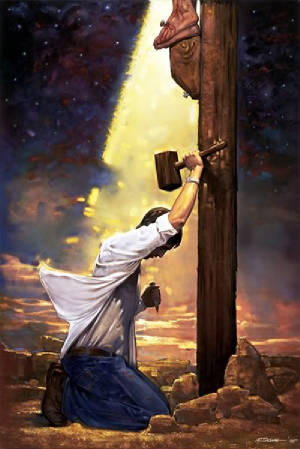
Our sins nailed Him to the Cross - but it is at the Cross that He won our salvation. Source here.
Now think about what happens at the Cross. The Father and the Son have been defined by their love for one another for eternity, and yet at this one point in our history, the relationship is broken, the Father turns His love away, and treats the Son, not as His obedient Son, but as an enemy - as one of those who has ruined everything - think how that must feel. I guess the closest you can get is to imagine how you would feel if the person who showed you the must love throughout your life, who had loved you unconditionally for the 70 years of your life, who you had also acted towards with nothing but selflessness and kindness turned on you and attacked you and insulted you and treated you like you had ruined their life - only much much worse. And yet that was the plan, the Son who had done nothing but obey the Father was treated like an enemy, in the exact moment He was being most obedient. And that is what it took to bring us back to God - that is what it required to make us clean and new and good. That's what your God did for you.
But it gets better than that. It's not just the extraordinary act of sacrifice to forgive us, it is the fact that now the Bible says we have been adopted into God's family. We are children of God. You know how God the Son is called God the Son? Well, the Bible says we are in God's family, 'in Christ' - which means that through Christ, we are also in the Trinity. We are no longer enemies, but we have been invited into the overflowing love of the Trinity through Jesus - we are a part of that now. Ever wonder how much God loves you? That's how much. That's also how secure you are, Christian. You are bound as tightly to God as the persons of God are to each other - God will never let you go.

No other belief in the world offers you such a God - a God who created you to love you, who is so selfless that He comes to save you, forgives you, suffers for you, does it all for you, and then invites you to share in the relationship that is part of His very being. That is why the god that philosophy and popular culture thinks of is not the God of the Bible at all. Only this God is worth worshipping, worth following, and boy does He give us a million reasons to. Wow, just wow.


Well, thank you for following this series, I hope it was encouraging. If you want more of that, phrased more eloquently than my splurging, read Denise's transcripts of or (even better) listen to these talks on the Trinity by Mike Reeves. If you read nothing else ever, outside the Bible, read these, please. I'll even beg if it helps:
The Heart-Winning God
The Loving Father
The Beautiful Son
The Heart-Melting Spirit

Friday, 30 March 2012

God is not the 'god' of Philosophy: Part 1 Reasoning From Ourselves

I may be a computer scientist, but philosophy has been one of my casual interests for a few years. Recently, however, there's something about Western philosophy that bothers me. Western philosophy spends a lot of its time debating questions about God and whether God exists, which is fine, it's the most important topic there is, but the more theology I read, the more I feel that philosophy doesn't do a good enough job. In fact, what I've come to think, is that the approach to the question is fundamentally flawed.

It's a bit of a long old topic, so I'll do it over two posts, but I want to look at the key points that we really need to know about God that we just can't get from philosophy, and why.

Problem 1: Reasoning from ourselves
Philosophers are the intellectual descendants of the Greeks, via the Renaissance and the Enlightenment. What this means is that rationality is terribly important. In other words, if I think long enough and logically enough about something, I can work it. Well, that seems fair enough - that's basically how science works (with the addition of using experiments to establish the validity of the reasoning). But the problem is that it's actually a bit of an arrogant attitude, believing that everything is within the capacity of human thought - and so it works fine for the world around us that we can grasp, but when it comes to the transcendent, things beyond our environment, it's simply not enough.
'School of Athens' by Raphael - Aristotle & Plato in the centre. Source here.
I'll be frank, I'm fully convinced that we can establish the existence of a deity by looking at the world around us. I think it's patently obvious - and I think there's a certain degree of wilful blindness going on when it comes to thinking otherwise. However, even accepting that, it's difficult to go much further than that if we start from ourselves. Starting from me and my experience of the world, plus the experience of others, just doesn't give us enough.
Using the world and our reason as our only sources of information about a god leaves us with an open question, such as the Buddhist answer (the Buddha is quite an adept analyst of the problematic state of the world and how it seems to work, but Buddhism doesn't give us a lot of concrete answers about why it's that way), or perhaps with the polytheism of the ancient world (we laugh at the Greco-Roman ideas, but it had a certain logic to it - they were simply interpreting the world as they saw it), or perhaps the atheistic approach - which rather than explaining everything with lots of gods, tries to explain everything with no gods at all. These ideologies get some things right - they all identify that life is often full of difficulties and suffering (esp. if you live outside the shelter of the first world middle classes) - but they conclude that therefore, the ruling force behind it all is of the same temperament. The Greco-Roman gods were capricious and cruel, the blind forces of evolution are bloody and thoughtless, the machine of Karma is, whilst fair, unmerciful.
The Buddhist Wheel of Life, depicting the cycle of reincarnation. Source here.
But what if God is deeper than that? What if the state of the world as we perceive it doesn't tell the whole story? What if, in fact, this is not the way things were to start with, and the confused state of the world reflects a bigger picture?

The Bible paints a picture of a God love and mercy, who created the universe by His power for the enjoyment of the creation. The purpose: to display His glory - which is exhibited first and foremost in His love. 1 John 4:8 says 'God is love'. Love is the very essence of who God is, and He created the universe to display His love. The pinnacle of that creation? Humanity, made in His image, to enjoy a relationship with Him so that they can have the joy of marvelling at His greatness and knowing Him personally. That, however, is a far cry from the world we live in. A world of disease, disaster and death hardly seems the work of such a God. The answer in many ways is a simple one, sin. Mankind's rejection of God's love and God's wisdom, pursuing self-interest and self-gratification. Buddhism spots this problem of sin and the selfishness of mankind. Karmic justice is its answer - bad actions now mean a bad life later, good actions now, a good one. The ultimate goal? Escape the cycle into oblivion in Nirvana. However, there is no explanation (as far as I know) as to why the world is this way. The Bible tells us why - Adam sinned, and from that the whole of creation is fallen, destined for destruction - it's been ruined. But the Bible it also gives us hope. It doesn't tell us to do everything we can to escape existence, rather it gives us a promise of a new creation, populated by those who have been saved from the horror of sin. And that hope comes because of the death and resurrection of Jesus taking the place of punishment and rejection that rightly belongs to those who have wrecked God's perfect creation - in other words, us. God has not given us up to destruction - He is redeeming and renewing us. All who put their trust in Jesus and His perfect work, rather than relying on themselves, are forgiven, made new - and will have eternal joy in the new Heavens and new Earth.
And this is where philosophy fails us. It cannot tell us any of that. It can only look at a snapshot of the part of the world we can see. So you have to go a step further - rather than starting with man and reasoning to god, go to the source of knowledge - start with God and work back. To do that we need God to reveal Himself - who He is, what His plan is, what He is like. God has done just that. Through His words in the Bible, and in person and in action through Jesus Christ. Jesus claimed that if you have seen Him you have seen the Father (John 14:9-11) - in other words, Jesus is God, and thus He reveals God and His character to us.

How is that character displayed? What is God like? Jesus displays God's character and heart on the Cross. When the Son of God - through whom the very world was created (see John 1) - humbled Himself to become part of His creation and the immortal, eternal God was killed - by His creation, by those very people He came to save - in order that they could be saved from the destruction that they had wilfully brought upon themselves.
As I commented the other day, our God, the true God, is humble and powerful, but, above all, love. More on that in the next post.

Wednesday, 23 November 2011

Furniture is heavy. Conversations while moving furniture can also be heavy.

I did a day's temp work yesterday shifting furniture at a local furniture shop - double beds, sofa beds, bookcases, wardrobes, that sort of thing. Turns out that a) they don't sell cheap and nasty mdf furniture, and b) real wood is really heavy.

I also spent a fair chunk of the afternoon debating belief in God with one of the other temps who was there that day. I used to do it loads at school in philosophy lessons, but I've been learning recently about the distinction between simply arguing generically for the existence of 'god', and actually pointing someone to Jesus. The problem with arguing in the abstract is that I'm not really trying to defend belief in 'a god', only belief in the one true God of the Bible. I'm not trying to say 'religion is good' - false religion isn't good - I'm actually kinda with Richard Dawkins on that much.
Ultimately the reason I believe in God, and think Him worth following, isn't because of the Design Argument or the Cosmological Argument (or even the Ontological Argument), it's because I believe in the death and resurrection of Jesus - who was God and man and died to take away my sin, rising again to prove that He had succeeded.

These are the most important questions to answer: who is Jesus? Was He really God? What did He do when He died? Did He rise again? And therefore - can I have a relationship with a God who loves me?
The Death and Resurrection of Jesus is the thing that the whole Bible hinges on - the Old Testament points towards it, and the New Testament exists because of it. All other apologetics are to some extent secondary, they are bridges to these questions - the identity and work of Jesus is of first importance. It is the proof of the validity of the whole Bible and it is the revelation of the character of the God of love and it is the way we can be reconciled to God. (For more on the love of God, check out the latest post on Denise's blog.)

How people respond to Jesus will govern how they respond to God ('if you've seen me you've seen the Father'). I still think apologetics questions are worth answering - but if you never come to the question of Jesus and the Gospel, you won't be coming to the true God.

I'm still learning how to effectively move a conversation from abstract intellectual stuff onto the Gospel - any thoughts? How would you go about that kind of conversation?

And what do you think of Jesus? Is He who He said He is - and why?

ShareThis